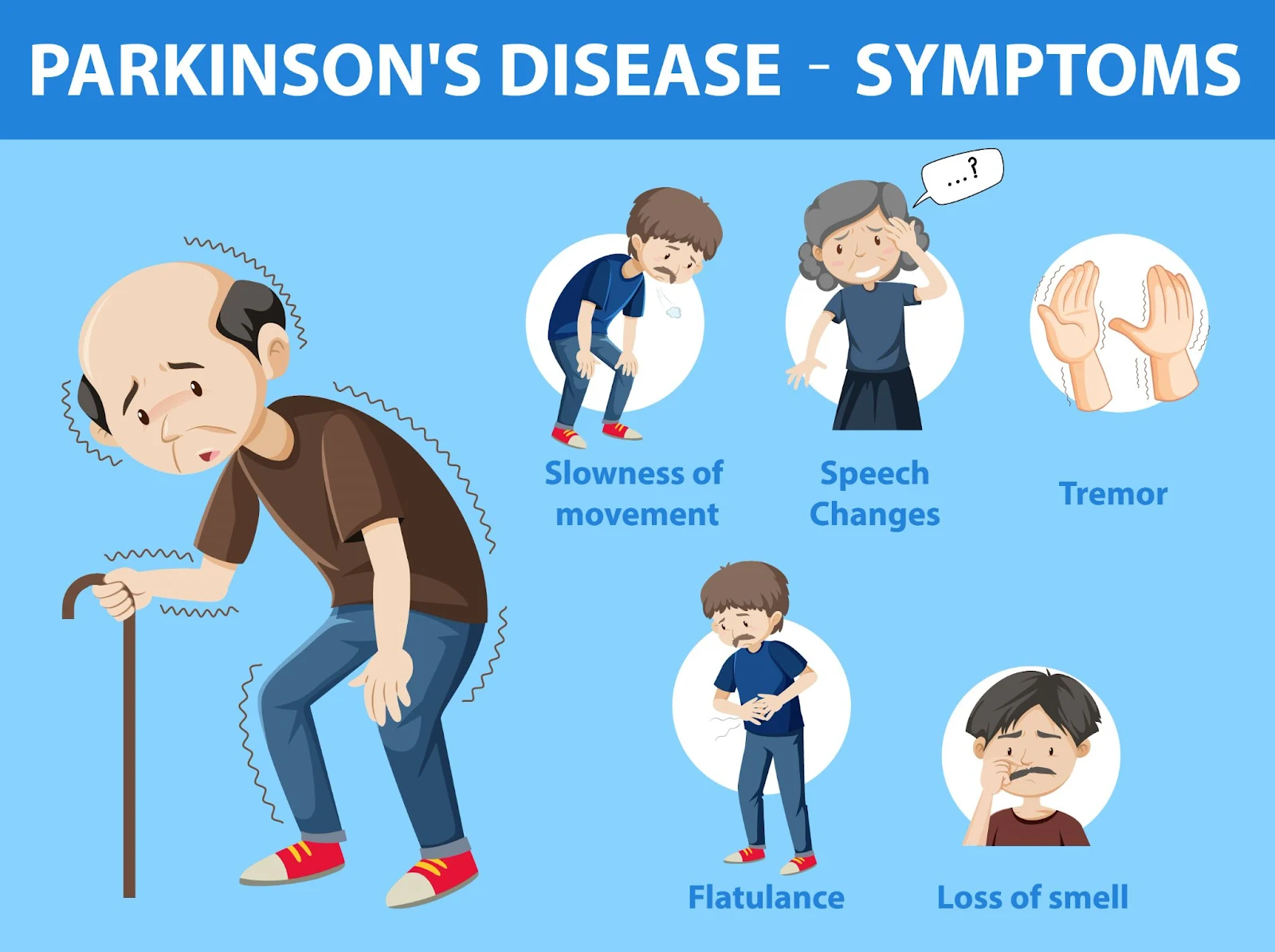
Symptoms of Parkinson’s Disease [PD]: Parkinson’s disease has several non-motor (non-movement) symptoms and motor (movement-related) symptoms. Non-motor symptoms sometimes appear several years ahead of motor symptoms, which may be considered potential warning signs.
Both types of signs are listed below:
Possible early non-motor (nonmovement-related) symptoms: Loss of sense of smell (Anosmia). Depression Unintentional flow of saliva from the mouth ( Drooling). Parkinson-related Dementia or other cognitive problems -
 Memory, thinking, focussing, learning, remembering, visuospatial skills, attention, language, reasoning, or other mental and cognitive skills may be affected. Memory, thinking, focussing, learning, remembering, visuospatial skills, attention, language, reasoning, or other mental and cognitive skills may be affected.
 Cognitive problems become more severe in the late stages of PD, and some people are diagnosed with Parkinson's disease dementia. Cognitive problems become more severe in the late stages of PD, and some people are diagnosed with Parkinson's disease dementia.
 Orthostatic hypotension: Irregular blood pressure and heart rate. Blood pressure drops all of a sudden when a person stands up from a lying down or seated position. It causes dizziness and lightheadedness. Loss of balance or fainting is also possible in extreme cases. Orthostatic hypotension: Irregular blood pressure and heart rate. Blood pressure drops all of a sudden when a person stands up from a lying down or seated position. It causes dizziness and lightheadedness. Loss of balance or fainting is also possible in extreme cases.
 Constipation Constipation
 Gastrointestinal problems Gastrointestinal problems
 Urinary incontinence Urinary incontinence
 Sexual dysfunctions - PD affects nerve signals from the brain; therefore, it can cause sexual dysfunction. Depression due to PD or the use of certain medications may also cause decreased sex drive and other sexual dysfunction. Sexual dysfunctions - PD affects nerve signals from the brain; therefore, it can cause sexual dysfunction. Depression due to PD or the use of certain medications may also cause decreased sex drive and other sexual dysfunction.
 Slow, cramped, and small handwriting (Micrographia) - This is due to poor control of hand muscles. Slow, cramped, and small handwriting (Micrographia) - This is due to poor control of hand muscles.
 Changes in the voice Changes in the voice
 Stooped posture (forward-bent position of head and trunk). Stooped posture (forward-bent position of head and trunk).
Major primary motor-related difficulties: (Motor impairment; movement-related) symptoms:
Slowed movement (Bradikensia)- It is not due to muscle weakness but instead due to poor control of muscle movement. It is a slowing down of spontaneous and automatic movement. It can make simple tasks more difficult, and activities that a person could once perform quickly and easily, such as washing or dressing, may take much longer.
Tremors (involuntary shaking of body parts) and rhythmic (back and forth motion) movement of muscles at rest : Tremors in hands, arms, jaw, legs, and/or head. It happens in 80% of people with PD. It is the rhythmic shaking of muscles when they are not in use. It is different from essential tremors, which usually do not happen when muscles are at rest.
Mostly, the tremor will cause the person to rub their thumb and forefinger together, which may appear as pill-rolling. It is most obvious when the hand is at rest or when a person is under stress. This tremor usually disappears during sleep and may improve when the person makes a purposeful, intended movement.
Muscle rigidity, inflexibility, stiffness of the limbs, arms, legs, and trunk- or resistance to the movement - Most common in the arms, shoulders, or neck. The muscles stay tense and tight, causing the person to ache or feel stiff. If another person tries to move the individual's arm, it moves only in short, jerky movements.
Muscle stiffness if contracted for a long time. Lead-pipe rigidity and Cogwheel stiffness are the common symptoms of PD. In lead-pipe rigidity, it is felt that limbs are stuck in one position, and the symptom of continuous resistance throughout the range of motion is observed. In Cogwheel stiffness, you may feel the symptoms of tremors and lead pipe rigidity together. Limbs move with jerks like the second hand of a mechanical clock.
Balance problem and tendency to fall - It is caused by abnormal movement of legs and/or arms, uncontrolled and unintended movements like shaking, stiffness, difficulty in balance, and mis-coordination of body parts.
Secondary Symptoms: Some of the secondary symptoms of PD are listed below:  Muffled, low-volume speech: Most individuals with PD have speech difficulties, which may include speaking quietly or in a monotone. Some people may hesitate before speaking, slur, or speak too quickly. This is due to poor control of the muscles of the chest and throat. Muffled, low-volume speech: Most individuals with PD have speech difficulties, which may include speaking quietly or in a monotone. Some people may hesitate before speaking, slur, or speak too quickly. This is due to poor control of the muscles of the chest and throat.
 Parkinsonian gait includes tendencies to take shuffling steps while walking to lean forward, taking small, quick steps as if hurrying (called festination), initiating and continuing the movement of arms, and reduced swinging in one or both arms. Parkinsonian gait includes tendencies to take shuffling steps while walking to lean forward, taking small, quick steps as if hurrying (called festination), initiating and continuing the movement of arms, and reduced swinging in one or both arms.
 It will be visible when they walk because they will use shorter, stuffing strides and move their arms less. It will be visible when they walk because they will use shorter, stuffing strides and move their arms less.
 During turn on-walk, they may take several steps. During turn on-walk, they may take several steps.
 They may have trouble initiating movement (called start hesitation) and stop suddenly as they walk ( freezing in place). They may have trouble initiating movement (called start hesitation) and stop suddenly as they walk ( freezing in place).
 Tendency to fall backward. Tendency to fall backward.
 Reduced arm swinging when walking. Reduced arm swinging when walking.
 A tendency to get stuck when walking. A tendency to get stuck when walking.
 Symptoms may start on one side of a limb or body part. Gradually, it may spread to all; however, it may remain more serious on one side. Symptoms may start on one side of a limb or body part. Gradually, it may spread to all; however, it may remain more serious on one side.
 It happens as the PD progresses. It happens as the PD progresses.
Other associated symptoms of Parkinson’s Disease [PD]: There may be several other associated symptoms of PD, some of which are listed below: Increased facial oil, especially on the forehead, at the sides of the nose, and on the scalp. An oily scalp makes dandruff. Some people's skin may be dry, and they may sweat more than usual. Flaky white or yellow scales on oily parts of the skin, known as Seborrheic Dermatitis. Increased risk of Melanoma, a serious type of skin cancer.
The rigidity and lack of normal movement may cause muscle cramps, especially in the legs and toes. Sustained muscle contractions that cause forced or twisted positions are also noticed in PD patients. It is called Dystonia.
Fatigue and loss of energy: Fatigue, especially late in the day, is also noticed in PD cases. It may be due to depression or sleep disorders, but it may be due to other reasons like motor control issues such as trouble initiating or carrying out movement, tremors, or stiffness.
Sleeping disorders (insomnia) Difficulty staying asleep during the night Emotional dreams Nightmares, Drowsiness, Suddenly falling asleep during the daytime. Periodic Limb Movement Disorder (PLMD) Rapid Eye Movement (REM) behavior disorder. People act out their dreams. It may be harmful to themselves or their bed partners. Restless legs syndrome. Sleep disturbances include vivid dreams, talking, and movement during sleep.
 Anxiety (insomnia), fatigue, and memory problems. Anxiety (insomnia), fatigue, and memory problems.
 Hallucinations. Hallucinations.
 Psychosis. Psychosis.
 Problems with attention and memory. Problems with attention and memory.
 Difficulty with visual-spatial relationships. Difficulty with visual-spatial relationships.
Difficulties in chewing, moving, talking, and stretching. Slow movement of food through the digestive tract. Difficulty in getting out of the chair. Loss of control of muscles. Pain: Due to rigidity and abnormal postures. The PD patients may have aches and pain in muscles and joints. As the disease progresses, people may develop Parkinson's dementia or Lewy body dementia. Gradual loss of spontaneous movement - It leads to decreased mental skill or reaction time, voice changes, decreased facial expression, etc. Gradual loss of automatic movement - It leads to decreased blinking, decreased frequency of swallowing, and drooling. A stooped, flexed posture with bending at the elbows, knees, and hips.
Note: Similar symptoms may be seen due to aging and/or some other reasons. Only a neurologist can diagnose, detect, and confirm Parkinson’s Diseases.
|



















.png)

Comments
Post a Comment
Thank you, most welcome, 👍